PHYSICS 1060 Dr Mike Fanelli
Fall 2004
REVIEW SHEET #1
This review sheet covers these topics:
The Scale of the Universe Patterns and Motions of the
Celestial Sphere, Constellations, Lunar and Planetary Motions,
Distances Measures, History of Astronomy from Antiquity to
our Modern View, Newton, Forces and Gravity.
Use these pages as a study guide-- i.e., a list of terms,
facts, concepts, and relationships that you will want to understand for
the exams. This review is NOT intended as a synopis of the
class notes or textbook. Rather, it mixes some factual information with
lists of items that students should review.
Sample questions, some given with answers, some without, are included.
These are indicated with a preceding "Q?" symbol.
This guide is not guaranteed to be comprehensive - tests cover
the text and notes !
A. DEFINITIONS & FACTS
As in any discipline, there are many terms and expressions whose
definitions are vital for an understanding of astronomy. Make use
of the end-of-chapter reviews in the text, where many terms are
highlighted. Also be aware of those terms specifically described
in your class notes.
Distance Measures: Be aware of how distances are
defined, and the actual values of the most important distance, e.g.,
the Earth-Sun distance.
- An Astronomical Unit (AU) = the Earth-Sun distance.
- 1 AU = 150 x 106 kilometers.
- Light (and radio waves) travels at 300,000 kilometers per second.
- A light year (LY) = distance light travels in a year
- 1 LY = 6 x 10¹² miles = 3 x 10¹³ kilometers.
- The Moon is 1.3 light seconds from Earth.
- Light takes about 8 minutes to travel from the Sun to the Earth.
- The Solar System is about 11 light hours in diameter.
- The nearest star is 4.3 light years distant.
Know that the universe is best estimated to be about 14 billion years old
(according to present data).
Stars & Constellations:
What is visible in the night sky ?
Q? What is a 'constellation' ? How many constellations are there ?
Be aware of the names of prominent/important stars & constellations.
- Constellations mark specific locations on the sky, all parts of the
sky are located in one of 88 constallations.
- Polaris is the "North Star", and marks the position on
the sky of the Earth's rotation axis.
- There is no "South Star".
- The Big Dipper is located in Ursa Major.
- The "Summer Triangle" is made up of the stars Vega, Deneb
and Altair.
- Orion is a prominent constellation in the winter sky.
- Sirius is the brightest star in the sky.
Celestial Sphere: Know your way around the celestial
sphere. Define the following, and be able to draw or identify each
on a representation of the celestial sphere.
- North Celestial Pole, celestial equator, the meridian
- Altitude, azimuth, horizon, zenith
- Ecliptic, zodiac, zodical constellations, equinox and solstice points
- Right ascension and declination
Understand how your location on Earth and the time of day affect which portions
of the celestial sphere you can see.
- Q? What are circumpolar constellations ?
- Q? How does your latitude determine the "amount" of the celestial
sphere visible from any specified location on Earth ?
- Q? How does the celestial sphere change during the course of a night ?
Lunar Motions and Phases:
- Define new and full Moon, first quarter and last quarter phases,
waxing and waning gibbous phases.
- Know where the Moon is located in its orbit around the Sun
at each phase.
- Be aware of the location of the Moon on the sky at each phase
(new, full, 1st quarter, 3rd quarter) with respect to sunset and sunrise.
When does a full Moon rise ? A new Moon ?
- What is the length of the lunar sidereal and synodic month ?
What are they ?
Eclipses:
- Understand the differences between total, annular and
partial solar eclipses.
- Visualize the shadow pattern cast by the Earth & Moon: the
umbra and penumbra.
- Understand what is meant by a total and partial
lunar eclipse.
- Review when solar and lunar eclipses occur. What is the
appropriate lunar phases during which a solar or lunar eclipse occurs ?
Planetary Motion and Models of the Solar System.
Understand these terms, and be able to sketch them:
- retrograde motion
- epicycles and deferents
- the geocentric universe model
- the heliocentric universe model
Newton's Laws of Motion and the Law of Gravity:
Understand the definition of each.
- #1 - the inertial law
- #2 - the force law - F = m x a
- #3 - the reaction law
- the law of gravity - the gravitational force between 2 objects
is related to the product of the masses of the objects divided by
the square of the distance between the objects. The law of
gravity is an example of an inverse square law.
Motions and Forces:
Be able to define mass, speed, velocity, and acceleration.
B. CONCEPTS
Earth's daily rotation :
- is responsible for the day/night cycle.
- is in the direction from WEST to EAST, which causes objects to rise
in the EAST and set in the WEST.
- be able to visualize/describe the daily motions of the stars, sun,
and moon across the sky, as seen at different latitudes on earth.
- Q? Where on earth do the stars travel parallel to the
horizon during the day/night? Perpendicular
to the horizon? How do stars move across the sky in Denton ?
Earth's annual orbital motion:
- causes us to see different parts of the sky during the year.
(e.g., the "Summer triangle" is not overhead at night during the
winter months).
- the sun to appear to travel on the imaginary circle called the
ecliptic.
- Q? If the earth did not rotate, would the sun still
travel along the ecliptic?
- Q? If the Earth rotated once per revolution about the Sun,
what would an observer see ?
- Be able to visualize the celestial equator and ecliptic on the sky.
Earth's orbital motion PLUS the 23.5° tilt of the
rotational axis causes:
- the seasons
- the sun's rising/setting position to "move" along the horizon
during the year.
- Be able to describe how the sun appears in the sky during the year, at
any particular place on the earth.
The Moon's orbital motion about the Earth:
- causes the monthly lunar phase cycle.
- results in an angular speed against the background stars
of 0.5° per hour, or about 13° per day.
- occurs in an eastward direction around the Earth (counterclockwise
when viewed from "above").
The lunar phase cycle:
- Understand why and how the different phases
occur (be able to draw a diagram to explain it).
- Be aware of the rising and setting times of various
lunar phases.
- Q? Does a waxing crescent moon rise earlier
or later than the new moon?
When does the new moon rise? When is the full moon on the
meridian?
Lunar rotation:
- The Moon rotates once per orbit about the Earth.
- causes Earth-bound observers to always see same side
of the Moon.
Solar and lunar eclipses:
- Understand their basic cause.
- Be able to sketch or label a diagram of an eclipse.
- Understand why everybody on the night side of the Earth
can witness a lunar eclipse, but only a very small fraction of
Earth's surface can see a solar eclipse.
- Why are total solar eclipses rare for any given location on Earth ?
- Q? Why doesn't a solar eclipse occur every time there is a new moon
(in other words, every month) ?
- Q? What types of eclipses would occur if the Moon was located a
few times further from the Earth than its current distance ?
A few times closer ?
Planetary Motions and their observed consequences here on Earth:
- All planets orbit eastward around the Sun, as viewed from
above.
- The further from the sun, the slower each planet's
angular speed across the sky.
- Understand what causes the retrograde motion of a planet against
the background stars.
- Understand the basic differences between the geocentric and
heliocentric models for the solar system, especially how
retrograde motion is explained in each model.
- Be able to explain how/why some models predicted stellar parallax,
and others didn't. In general, if the earth moves, then parallax
is predicted; if the earth is stationary, no parallax.
A little history: Be cognizant of the contributions of
the major "thinkers" who advanced our understanding of the Universe.
In particular, be able to order their work in time, and relate
one individual's work to others.
- Aristotle
- Erathosenes
- Aristarchus
- Ptolemy
- Copernicus
- Galileo
- Newton
- Herschell
- Hubble
The Modern World View: Review how our "worldview" changed from
the 2000-year-old geocentric model to the Sun-centered model of Copernicus.
- Q? What was wrong with Copernicus' basic model ?
- Q? What are the elements of the Copernican Principle ?
- Review how advances in technology help foment the Copernican Revolution
in the 1600s and the "second" revolution in the 1920s. ?
- Q? What specific discoveries of Galileo provided support for the
heliocentric model ?
- Be aware of the what is meant by the "First" Revolution in our
world view, and the "Second" revolution.
- Q? What are the spiral nebulae and how questions about their nature
help ignite the second revolution ?
Gravity, Forces and Motions: Isaac Newton developed
the physics of mechanics, which relates the motions of objects to
their mass and applied forces. Review Newton's laws of motion, why gravity
is just one example of a force, and how Newton discovered the "law" of
gravity, i.e., how the force of gravity defines the motions of objects in
space.
- Understand what is meant by each of Newton's laws of motion.
- Understand what would happen to a moving object if an applied
gravitational force is magically turned-off.
- Understand why the acceleration of a pebble and a boulder falling
from the same height above the Earth are identical, yet the
gravitational force that the Earth exerts on each of them is
different.
- Understand why the force exerted on the above pebble BY
the earth is exactly equal (but opposite in direction) to the
force exerted ON the earth BY the pebble.
- Understand why the Moon does not collide with Earth,
even though the Earth's gravitational force tends to pull
the moon directly in towards the Earth.
- Understand why the Moon orbits the Earth, rather than the
Earth orbiting the Moon. (But WHY is this the case, if the Moon
pulls just as hard on the Earth as the earth pulls on the
moon?)
- Understand why planets have longer orbital periods, the
further they are from the Sun. (This fact is expressed
by Kepler's 3rd law, and explained by the law of gravity.)
C. QUANTITATIVE RELATIONSHIPS
This section reviews specific quantitative (meaning mathematical)
relations, and how to interpret those relationships.
Some formulae:
| (1) |
Small Angle formula: |
true size = distance x angular size |
|
(2) |
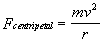
Centripedal force: |
 |
|
| (3) |
Gravitational Force: |
 |
|
(4) |
Newton's 2nd Law: |
 |
|
Scientific Notation & Orders-of-Magnitude:
Scientific notation is a set of rules for expressing very
large and very small numbers. Use the handout on this webpage
to review this notation and be able to translate a number
into its "English" eqivalent. Example: 1 billion = 109.
An "order-of-magnitude" refers to one unit in the exponent.
Angular size: Understand the meaning of angular size and the
system of units used to express these quantities.
- Angular measure is used to define a distance along an arc.
- There are 360°, or 2 p radians, in the
circumference of a circle.
- 1° = 60 arcminutes; 1 arcminute = 60 arcseconds.
- The circumference of a circle = p x
diameter or 2 x p x radius.
- The area of a circle is: p x
radius 2
- The volume of a sphere is: 4/3 x p x
radius 3 .
Be cognizant of the angular sizes of typical astronomical objects, and
how to estimate the angular size of an object in the sky.
- The Moon and Sun extend about 0.5°.
- A typical constellation is several degrees across
- Planets typically are observed to extend a few arcseconds up
to about 50 arcseconds on the sky. Q? Can you see this with
your eye ?
Angular Size and True Size: Know that the true or physical
size of an object (Moon, Sun, building, tree, etc) is directly
proportional to its angular size and the distance to the
object.
true size = distance × (angular size in
degrees / 57.3).
This relation is known as the small angle formula, and
allows the direct calculation of the size of an object if the distance
is known, or conversely, one can determine the distance to an object if
its true size is known. The small angle formula implies that the further
away that an object is located, the smaller its angular size
will be. If distance increases, then the angular size must
decrease.
Ellipses: Ellipses are geometric figures which can be
described as "flattened" circles. Planetary orbits trace ellipses. Know
what the eccentricity of an ellipse measures (for a circle, e = 0).
Be able to draw an ellipse with a planet and the Sun properly oriented.
Q? The more "squashed" (flattened) an ellipse, the closer
the value of eccentricity is to _______ ?
Understand how to describe forces:
- Any and all forces can be described by Newton's Second Law:
F = m × a
where F = the force exterted ON an object, m = mass of an object,
a = acceleration of an object, due to application of a force.
- The force due to gravity is expressed:
Know what the symbols "m" and "r" mean in different situations.
Q? How does the force of gravity change if your distance from a massive
object doubles ? triples ?
- A force that causes an object to execute circular motion (i.e., force
of gravity, which causes a planet to move within a circular orbit):
where F = the force causing the circular motion,
m = the mass of the object that is in circular motion, r = the radius of
circular motion, v = the speed of an object along its circular path.
Escape velocity: Defined as the velocity needed to escape the
gravitational pull of a planet or other massive object.
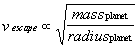 Q? How does the escape velocity change if the mass of an object is
increased ?
Q? How does the escape velocity change if the mass of an object is
increased ?
Q? How does the escape velocity change if the radius of an
object is increased while the mass remains constant ?